Jute Fiber as a Sustainable Reinforcement for Improving the Performance of RCA Concrete
Bilah Samping Artikel
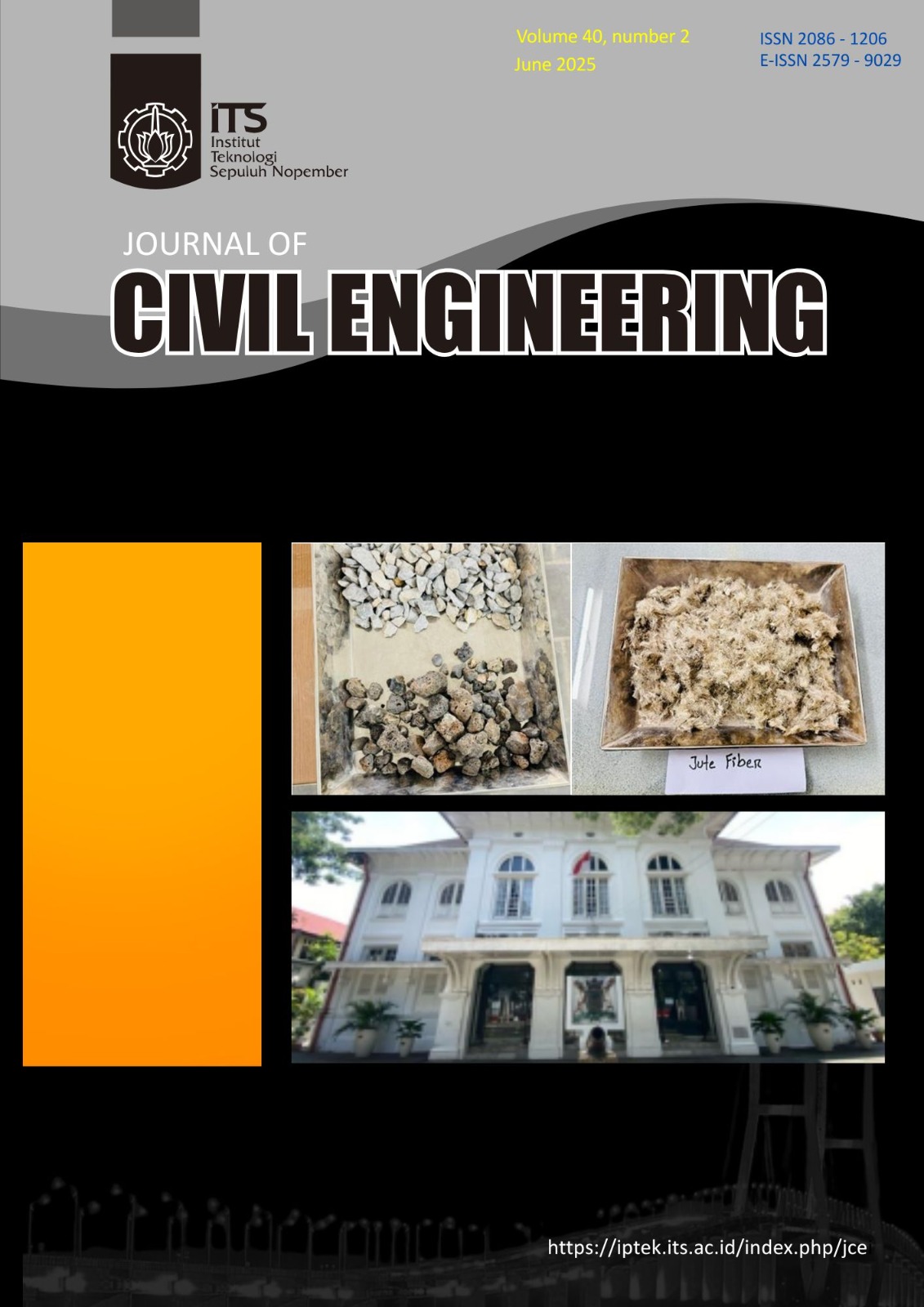
Isi Artikel Utama
Abstrak
Concrete demand growth in construction keeps pushing the construction industry to exploit natural aggregates beyond safety levels while damaging the environment and raising carbon pollution levels. The use of recycled Concrete Aggregate (RCA) as a sustainable solution results in compromised mechanical values and durability because of its high porosity together with weak interfacial transition zones (ITZ). The research investigates Jute Fiber (JF) reinforcement systems as a method to boost mechanical characteristics in concrete made from recycled concrete aggregates. This investigation evaluated the effect of changing JF levels from 0.15 to 0.35 percent and the use of 25 to 100 percent RCA while studying concrete workability, compressive strength, split tensile strength, and water absorption. Seventeen mixtures of concrete were tested which showed that workability alongside strength performance reduced because of the porous characteristics of RCA. JF showed its best mechanical impact when used with a combination of 0.15% concentration and 25% RCA content in the mixtures (J0.15R25). Fiber compressive strength and water absorption levels increased with greater than 0.25% fiber addition because the fibers clustered together while the JF absorbed more water. Research findings demonstrate that JF and RCA
merged as an effective method to provide durable concrete which presents improved durability and tensile strength as well as crack resistance. The successful implementation of this method depends on precise control of fiber content combined with correct replacement ratios between RCA and cement. Research findings enable progress in developing sustainable efficient construction concrete materials for the building sector.