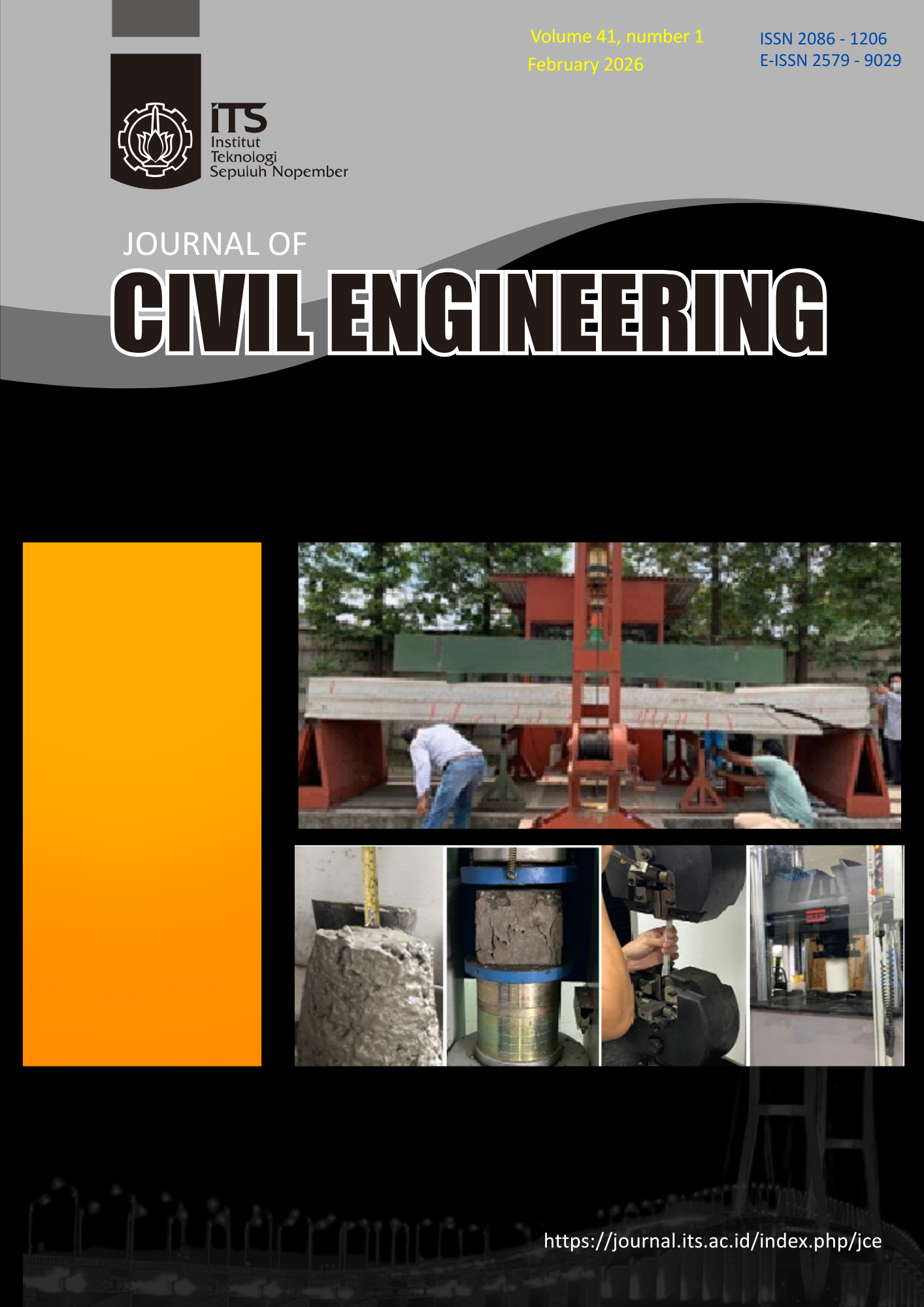
Flexural Load Testing of Hollow Core Slab Systems with Added Concrete Topping
DOI:
https://doi.org/10.12962/j25799029.v41i1.9506Keywords:
Composite action, roughing, cracking, toppingAbstract
Hollow Core Slabs (HCS) are widely applied in multi-story buildings due to their efficiency and prestressed concrete system. The use of cast-in-place concrete topping is intended to enhance structural performance; however, sufficient composite action between the HCS and topping must be ensured. ACI 318-14 Section 16.4.4.2 specifies a minimum surface roughening depth of ¼ in. (6.35 mm) to achieve composite action between concrete elements. This study investigates the effectiveness of a reduced roughening depth of 2 mm in developing composite behavior between HCS and topping. Full-scale HCS specimens with additional toppings were experimentally tested under cyclic loading using a load-control method. Composite action was evaluated based on load response, stiffness degradation, and crack pattern observations. The experimental results demonstrate that a roughening depth of 2 mm is insufficient to develop composite action, as cracking was concentrated along the interface between the HCS and topping. These findings confirm the necessity of complying with the minimum roughening depth requirements specified in ACI 318-14