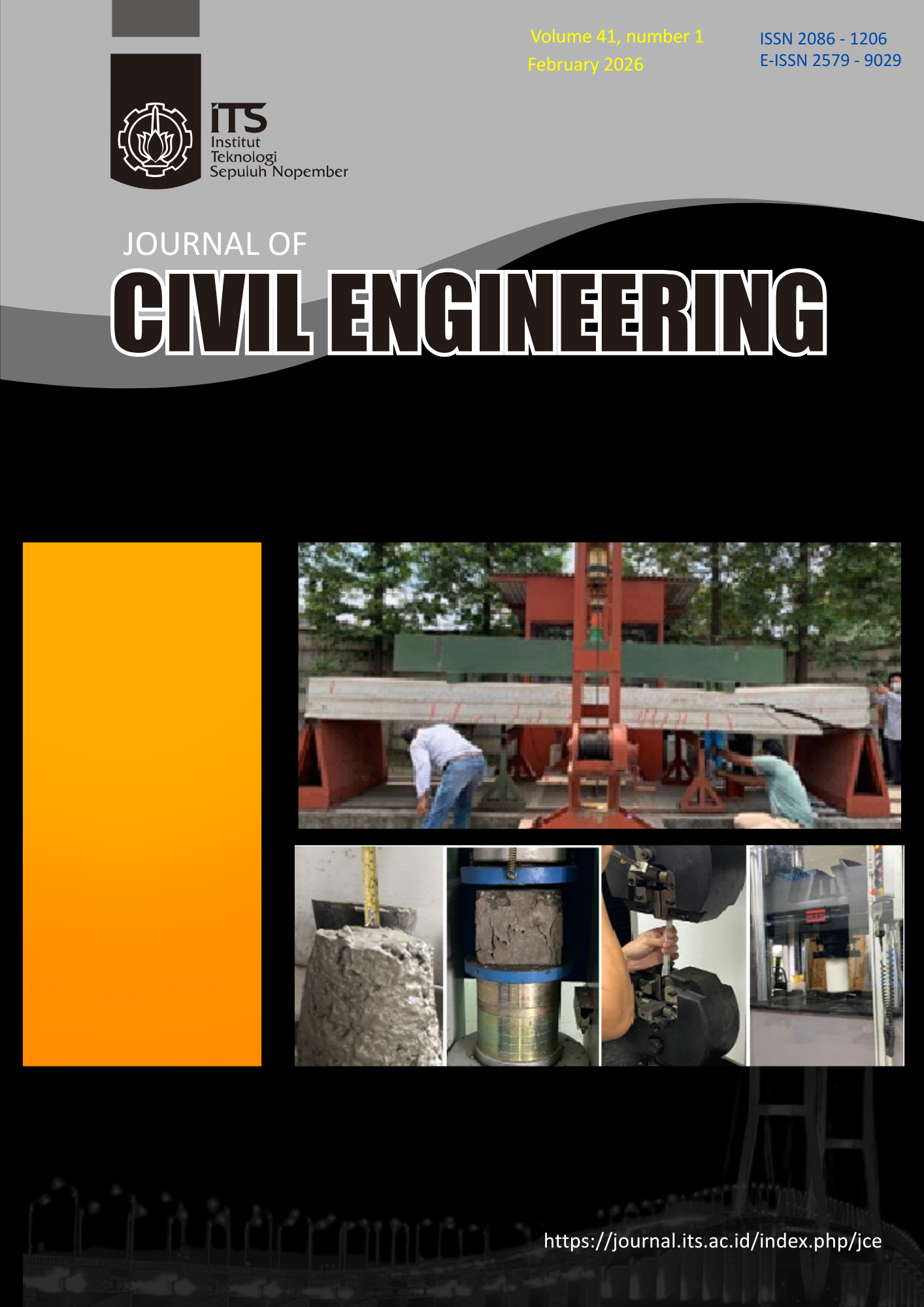
Experimental Study on Concrete-Filled PVC Tubes Using E-Glass Fibre Reinforced Concrete
DOI:
https://doi.org/10.12962/j25799029.v41i1.9495Kata Kunci:
E-glass fibre reinforced concrete, tube confinement, compressive strength, fibre content, Concrete-filled plastic tubeAbstrak
Concrete-filled plastic tubes (CFPT) provide corrosion resistance compared to concrete-filled steel tubes but have low stiffness and tensile capacity, which weakens confinement. This study investigates E-glass fibre-reinforced concrete as infill to address these limitations. Compressive tests were conducted on 54 specimens in four groups: plain concrete (C), E-glass fibre reinforced concrete (EC), concrete-filled tube (CP), and E-glass fibre reinforced concrete-filled tube (ECP). Variables included specimen diameter (75–150 mm), fibre content (0–1.5% by cement weight), and confinement (with or without PVC tubes). Increasing diameter from 75 mm to 150 mm raised compressive strength by 2.1 to 4.9 times. The strength gain, however, was disproportionate to the increase in load-bearing area due to poor compaction, uneven fibre distribution, reduced confinement effectiveness, and slenderness effects. Adding E-glass fibres reduced strength by 10% to 56%, with variation likely caused by workability issues and fibre clustering. PVC confinement improved plain concrete strength proportionally to the 2t/d ratio but had inconsistent effects on fibre-reinforced mixes. Failure modes included bulging, shear, and tube bursting. Recommendations include improving workability, enhancing bonding, and increasing PVC tube stiffness to optimise CFPT performance.