Optimization of Authentication Methods for Processed Chicken Meat Products Based on ND5 Gene qPCR
Bilah Samping Artikel
Isi Artikel Utama
Abstrak
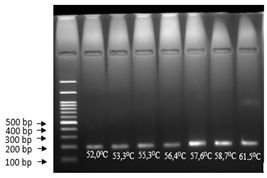
Consumers have the right to correct information about the products they consume. One example of a food product that is vulnerable to counterfeiting is chicken nuggets. To overcome this problem, qPCR can be an effective solution. Previous research has designed primers targeting the chicken ND5 gene. However, the PCR conditions for this primer pair have never been optimized. This research aims to optimize qPCR conditions and carry out chicken nugget authentication trials. Genomic DNA was isolated from five weight variations of chicken meat samples as a qPCR standard curve and three chicken nugget samples. Optimizing the annealing temperature with gradient PCR gave the best results at a temperature of 57.6OC. The results of the authentication test showed that the chicken meat content in TD nuggets was 54.7%, C nuggets 43.8%, and D nuggets 37.3%. This value is still in accordance with the Indonesian National Standard (SNI).
Rincian Artikel

Artikel ini berlisensi Creative Commons Attribution-NonCommercial 4.0 International License.
Copyright
Authors who publish their manuscripts in this journal agree to the following terms:
- The copyright of each article remains with the authors.
- Halal Research Journal holds the right to publish the article first under the Creative Commons Attribution 4.0 International License.
- Authors may distribute their published manuscripts non-exclusively (e.g., to institutional repositories or as part of book publications), provided they acknowledge that the article was first published in this journal.
License
Articles published in this journal are licensed under the Creative Commons Attribution 4.0 International License. This license permits anyone to:
- Copy, distribute, adapt, modify, and create derivative works from the material in any form, including for commercial purposes.
- The condition is that proper credit must be given to the authors for the original work.
Referensi
L. MUI, "Inilah 7 Jenis Pemalsuan Pangan, " 2021. https://halalmui.org/inilah-7-jenis-pemalsuan-pangan/
R. D. Deshazo, S. Bigler, and L. B. Skipworth, "The autopsy of chicken nuggets reads ‘Chicken Little,’ " Am. J. Med., vol. 126, no. 11, pp. 1018–1019, 2013, doi: 10.1016/j.amjmed.2013.05.005.
L. MUI, "Is it possible that nuggets are not halal? " 2021. [Online]. Available: https://halalmui.org/mungkinkah-nugget-tidak-halal/
T. M. Fakih, S. Wijaya, and S. E. Priani, "Desain Primer Gen 12S sRNA dari DNA Mitrokondria Babi (Sus scrofa) secara In Silico sebagai Kandidat Primer dalam Analisis Molekuler Kehalalan Produk, " J. Sains Farm. Klin., vol. 8, no. 3, p. 316, 2021, doi: 10.25077/jsfk.8.3.316-322.2021.
F. Safitri, A. Achyar, and B. Metode, "In Silico Primer Design For Chicken ND5 Gene Amplification By Real-Time Polymerase Chain Reaction (rt- PCR) Desain Primer Secara In Silico Untuk Amplifikasi Gen ND5 Ayam Dengan Real-Time Polymerase Chain Reaction (rt- PCR) Abstrak Pendahuluan, " vol. 8, no. 3, pp. 476–479, 2023.
Y. Yuenleni, "Langkah-Langkah Optimasi Pcr, " Indones. J. Lab., vol. 1, no. 3, p. 51, 2019, doi: 10.22146/ijl.v1i3.48723.
A. Ludyasari, "Pengaruh Suhu Annealing pada Program PCR Terhadap Keberhasilan Amplifikasi DNA Udang Jari (Metapenaeus elegans De Man, 1907) Laguna Segara Anakan, Cilacap, Jawa Tengah’, " Malang: Skripsi Jurusan Biologi, Fakultas Sains dan Teknologi, Univeristas Islam Negeri Maulana Malik Ibrahim, 2014.
M. Asy’ari and A. S. Noer, "Optimasi Konsentrasi MgCl2 dan Suhu Annealing pada Proses Amplifikasi Multifragmens mtDNA dengan Metoda PCR, " J. Kim. Sains dan Apl., vol. 8, no. 1, pp. 23–27, 2005, doi: 10.14710/jksa.8.1.23-27.
D. Eling KS, R. Kurniawan, and I. Muhimmah, "Karakteristik Primer pada Polymerase Chain Reaction(PCR) untuk Sekuensing DNA: Mini Review, " Semin. Inform. Medis 2014, pp. 93–102, 2014, [Online]. Available: http://snimed.fit.uii.ac.id/
E. Martati, P. K. Kirana, and T. Mahatmanto, "Optimization of Real Time-Polymerase Chain Reaction ( RT-PCR ) Annealing Temperatures for the Detection of Superoxide Dismutase ( SOD ) in Wistar Rat ( Rattus novergicus ) Liver, " vol. 14, no. 2, 2024.
C. R. Tjampakasari, A. Yasmon, and ; Fitrahwati Sudarmo, "Deteksi Gen Msg untuk Peningkatkan Ketepatan Diagnosis Pneumocystis Jirovecii pada Pasien HIV dengan Pneumonia IJOBB, " Indones. J. Biotechnol. Biodivers., vol. 2, no. 1, 2018.
SNI, "Naget ayam (chicken nugget). Standar nasional indonesia 6683, " Badan Stand. Nas., p. Jakarta, 2014.
G. Dirong et al., "Omics-based analytical approaches for assessing chicken species and breeds in food authentication, " Molecules, vol. 26, no. 21, 2021, doi: 10.3390/molecules26216502.
M. A. M. Hossain et al., "Heptaplex polymerase chain reaction assay for the simultaneous detection of beef, buffalo, chicken, cat, dog, pork, and fish in raw and heat-treated food products, " J. Agric. Food Chem., vol. 67, no. 29, pp. 8268–8278, 2019, doi: 10.1021/acs.jafc.9b02518.
B. Konduru, S. Sagi, and M. Parida, "Dry reagent-based multiplex real-time PCR assays for specific identification of chicken, mutton, beef and pork in raw and processed meat products, " Eur. Food Res. Technol., vol. 247, Mar. 2021, doi: 10.1007/s00217-020-03662-1.
X.-J. SHEN, "Primer Design and Sequence Information for Complete Mitochondrial ND5 Gene in the Black and White Lines of Silky Fowl (Gallus gallus), " Nihon Chikusan Gakkaiho, vol. 72, no. 3, pp. 257–259, 2001, doi: 10.2508/chikusan.72.257.
K. M. Jonker, J. J. H. C. Tilburg, G. H. Hägele, and E. de Boer, "Species identification in meat products using real-time PCR, " Food Addit. Contam. - Part A Chem. Anal. Control. Expo. Risk Assess., vol. 25, no. 5, pp. 527–533, 2008, doi: 10.1080/02652030701584041.
J. S. Amaral, C. G. Santos, V. S. Melo, J. Costa, M. B. P. P. Oliveira, and I. Mafra, "Identification of duck, partridge, pheasant, quail, chicken and turkey meats by species-specific PCR assays to assess the authenticity of traditional game meat Alheira sausages, " Food Control, vol. 47, pp. 190–195, 2015, doi: 10.1016/j.foodcont.2014.07.009.
A. Di Pinto et al., "Occurrence of mislabeling in meat products using DNA-based assay, " J. Food Sci. Technol., vol. 52, no. 4, pp. 2479–2484, 2015, doi: 10.1007/s13197-014-1552-y.
K. H. Roux, "Optimization and Troubleshooting in PCR, " 2009.
H. R. Shehata et al., "Droplet digital polymerase chain reaction (ddPCR) assays integrated with an internal control for quantification of bovine, porcine, chicken and turkey species in food and feed, " PLoS One, vol. 12, no. 8, pp. 1–17, 2017, doi: 10.1371/journal.pone.0182872.
A. Lopez-Oceja, C. Nuñez, M. Baeta, D. Gamarra, and M. M. de Pancorbo, "Species identification in meat products: A new screening method based on high resolution melting analysis of cyt b gene, " Food Chem., vol. 237, pp. 701–706, 2017, doi: 10.1016/j.foodchem.2017.06.004.
M. J. Kim and H. Y. Kim, "A fast multiplex real-time PCR assay for simultaneous detection of pork, chicken, and beef in commercial processed meat products, " Lwt, vol. 114, no. June, p. 108390, 2019, doi: 10.1016/j.lwt.2019.108390.
M. Xiao, Y. Chen, H. Chu, and R. Yin, "Development of a polymerase chain reaction - Nucleic acid sensor assay for the rapid detection of chicken adulteration, " Lwt, vol. 131, no. May, p. 109679, 2020, doi: 10.1016/j.lwt.2020.109679.
O. Cetin, E. B. Bingol, E. Civan, S. I. Turgay, and O. Ergun, "Identification of animal species and foreign tissues in ready-to-sell fresh processed meat products, " Acta Aliment., vol. 45, no. 2, pp. 198–205, 2016, doi: 10.1556/AAlim.2015.0008.
J. qin LUO et al., "Development and Application of a PCR Approach for Detection of Bovis, Sheep, Pig, and Chicken Derived Materials in Feedstuff, " Agric. Sci. China, vol. 7, no. 10, pp. 1260–1266, 2008, doi: 10.1016/S1671-2927(08)60173-X.
C. Cammà, M. Di Domenico, and F. Monaco, "Development and validation of fast Real-Time PCR assays for species identification in raw and cooked meat mixtures, " Food Control, vol. 23, no. 2, pp. 400–404, 2012, doi: 10.1016/j.foodcont.2011.08.007.
P. Thanakiatkrai and T. Kitpipit, "Meat species identification by two direct-triplex real-time PCR assays using low resolution melting, " Food Chem., vol. 233, pp. 144–150, 2017, doi: 10.1016/j.foodchem.2017.04.090.