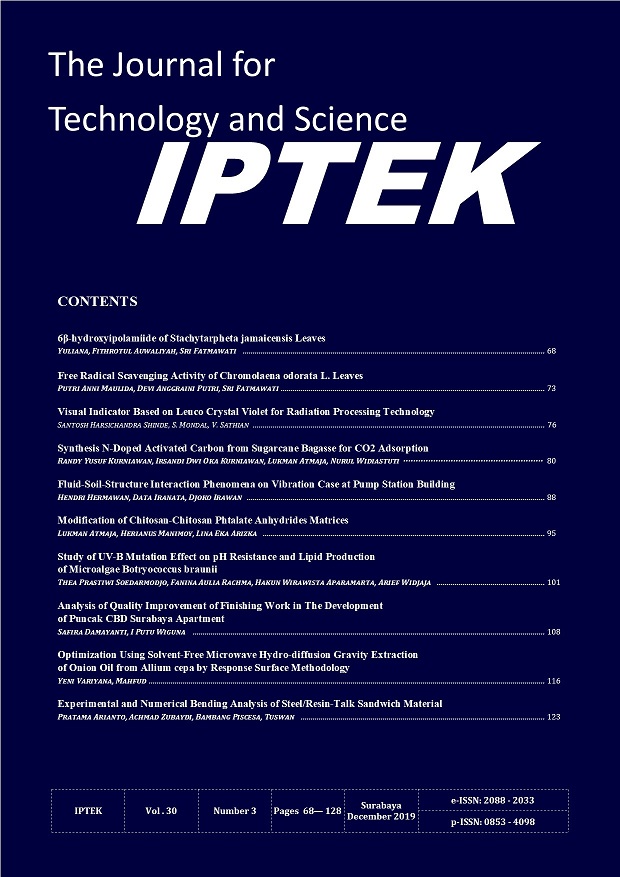
Synthesis N-Doped Activated Carbon from Sugarcane Bagasse for CO2 Adsorption
Article Sidebar
Published:
Jul 1, 2025
Keywords:
Nitrogen-doped Nitrogen-doped Activated Carbon, Sugarcane Bagasse, KOH and Urea Activation, CO2 Adsorption
Main Article Content
Abstract
Nitrogen-doped activated carbon (SBACN) was synthesized from sugarcane bagasse waste as acarbon source and urea as nitrogen source through potassium hydroxide (KOH) activation for 2 h at high temperature via two step methods. The synthesized SBCN was characterized using X-Ray Diffraction (XRD), Scanning Electron Microscope (SEM), and Fourier Transform Infrared (FTIR). The results showed that the SBCN has low degree crystallinity and graphitization with highly developed micropores due to synergistik activation effect of KOH and urea. These characteristics provide an important contribution to carbon dioxide adsorption capacity, which can reach up to 11,20% wt and this value is higher than pristine activated carbon. The results indicating that the presence of this nitrogen functionalities is found to have a beneficial influence on the carbon dioxide adsorption characteristic in standart condition and exhibit considerable potential in solid adsorption.
Article Details
How to Cite
Kurniawan, R. Y., Oka, I. D., Atmaja, L., & Widiastuti, N. (2025). Synthesis N-Doped Activated Carbon from Sugarcane Bagasse for CO2 Adsorption. IPTEK The Journal for Technology and Science, 30(3), 80–87. https://doi.org/10.12962/j20882033.v30i3.4324
Issue
Section
Articles