
Jurnal Penginderaan Jauh Indonesia
Platform jurnal dengan akses terbuka oleh ITS dan MAPIN yang menerbitkan penelitian orisinal di bidang sains dan teknologi penginderaan jauh untuk aplikasi darat, kelautan, dan atmosfer.
Ajukan NaskahTentang Jurnal Kami
Menyebarluaskan penelitian dan teknologi penginderaan jauh untuk aplikasi kebumian, kelautan, dan atmosfer.

Fokus dan Ruang Lingkup
Jurnal ini menerbitkan artikel penelitian orisinal, tinjauan (review), dan kajian ilmiah mengenai teori, sains, dan teknologi penginderaan jauh. Jurnal ini berfungsi sebagai wadah bagi peneliti dan profesional untuk berbagi kemajuan terbaru dalam bidang penginderaan jauh beserta aplikasinya.
JPJI berfokus pada penginderaan jauh terhadap objek-objek di permukaan Bumi, meliputi daratan, lautan, dan atmosfer. Jurnal ini menyoroti karya-karya inovatif yang berkontribusi pada pemahaman serta pemanfaatan penginderaan jauh untuk menjawab berbagai tantangan lingkungan dan ilmiah.
Diterbitkan oleh Institut Teknologi Sepuluh Nopember (ITS) bekerja sama dengan Masyarakat Pakar Penginderaan Jauh Indonesia (MAPIN/ISRS), JPJI mendorong pertukaran pengetahuan dalam komunitas penginderaan jauh.
Selengkapnya
Terbitan Terkini
Vol 6 No 1 (2027)
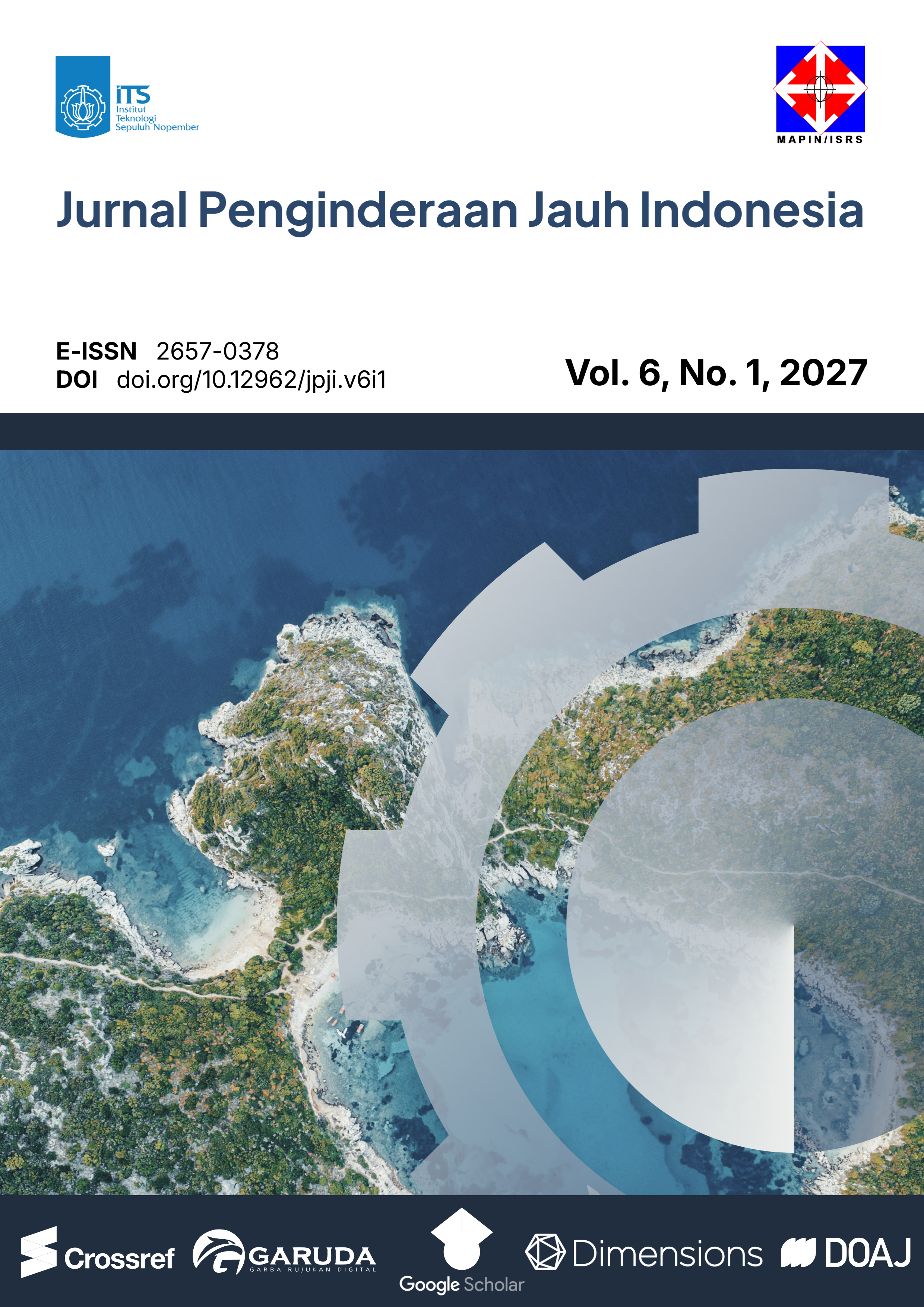
Diterbitkan: 07-09-2026
Panduan Pengiriman Naskah
Ikuti langkah-langkah berikut untuk mengirimkan naskah Anda
1 Ruang Lingkup & Bahasa
Jurnal Penginderaan Jauh Indonesia (JPJI) menerima artikel orisinal dalam Bahasa Indonesia maupun Bahasa Inggris yang berkaitan dengan bidang penginderaan jauh. Panjang naskah adalah 5–8 halaman dan harus mengikuti templat JPJI dengan menggunakan huruf Times New Roman, umumnya berukuran 10 pt.
2 Struktur Naskah
Naskah diawali dengan judul yang ringkas (maksimal 15 kata) serta informasi penulis yang mencakup nama lengkap, afiliasi, dan alamat email yang dicantumkan dalam catatan kaki (footnote). Sertakan abstrak maksimal 200 kata yang merangkum latar belakang, tujuan, metode, dan kesimpulan utama, diikuti oleh 3–6 kata kunci yang relevan.
3 Isi dan Format
Bahan dan metode harus dijelaskan secara jelas agar penelitian dapat direplikasi. Hasil disajikan secara ringkas dengan dukungan gambar atau tabel, serta menghindari pengulangan data. Pembahasan difokuskan pada temuan-temuan penting tanpa mengulang metode, serta menggunakan satuan baku sesuai Standar Nasional Indonesia (SNI). Singkatan yang tidak umum harus dijelaskan pada penggunaan pertama, dan nama latin spesies dicantumkan bersama nama umum pada penyebutan awal.
4 Sitasi dan Daftar Pustaka
Gunakan gaya sitasi IEEE dengan nomor referensi dalam tanda kurung siku [ ], yang dikelola melalui perangkat lunak seperti Mendeley atau Zotero. Contoh:
1 M. Jaelani et al., "An improved atmospheric correction algorithm...," Int. J. Appl. Earth Obs., vol. 39, hlm. 128–141, Jul. 2015.
5 Pengiriman Naskah dan Ucapan Terima Kasih
Penulis wajib memindahkan seluruh konten dengan opsi "Keep Text Only" untuk menjaga konsistensi format dalam templat. Ucapan terima kasih ditulis secara singkat (maksimal 40 kata) dan hanya mencantumkan dukungan pendanaan atau institusi yang esensial.
Statistik Jurnal:
Siap Mengirimkan Riset Anda?
Publikasikan karya terbaik Anda bersama Jurnal Penginderaan Jauh Indonesia
Unduh Template Panduan Detail Kirim SekarangTim Editorial
Dewan pakar terkemuka kami
Lalu Muhamad Jaelani
Pemimpin Redaksi
Departemen Teknik Geomatika, Institut Teknologi Sepuluh Nopember (ITS), Surabaya, Indonesia
(Scopus)
Anang Wahyu Sejati
Editor
Departemen Perencanaan Wilayah dan Kota, Universitas Diponegoro (Undip), Semarang, Indonesia
(Scopus)
Anjar Dimara Sakti
Editor
Departemen Teknik Geodesi & Geomatika, Institut Teknologi Bandung (ITB), Bandung, Indonesia
(Scopus)
Baba Barus
Editor
Departemen Ilmu Tanah dan Sumberdaya Lahan, Institut Pertanian Bogor (IPB), Bogor, Indonesia
(Scopus)
Bambang Sulistyo
Editor
Program Studi Ilmu Tanah, Fakultas Pertanian, Universitas Bengkulu (UniB), Bengkulu, Indonesia
(Scopus)
Jasyanto
Editor
Badan Riset dan Inovasi Nasional, Jakarta, Indonesia
Lihat Semua
Terindeks: