A Halal-Haram Studies: Food-Grade Lubricants in the Food Industry
Article Sidebar
Main Article Content
Abstract
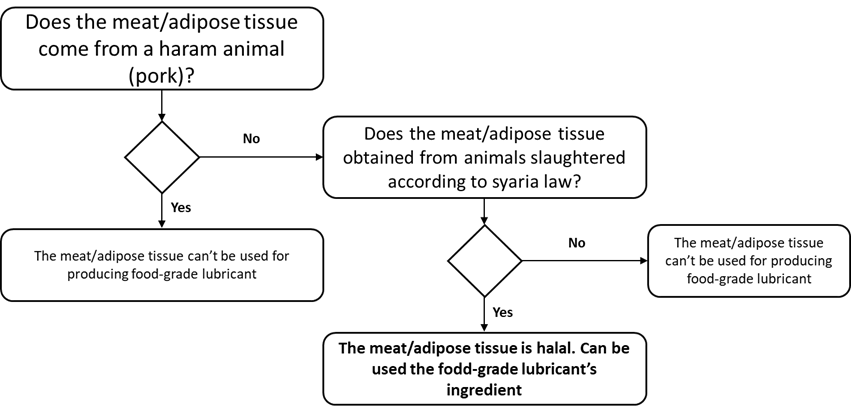
Food-grade lubricants are important in the food industry because they maintain the efficiency and safety of the production process. Halal and haram aspects in Islam are essential in food-grade lubricants because of potential contamination of lubricants in food products. The halal or haram status of a lubricant is determined by the raw materials, manufacturing process, and potential contamination of food-grade lubricants. Some food-grade lubricants use animal-derived raw materials such as stearic acid. The primary source of raw lubricant material is the animals used. The use of prohibited animals will change the status of lubricants to haram. In addition to raw materials, lubricant production can use non halal materials such as alcohols and catalysts. If the catalyst and alcohol used are not in accordance with SNI 99004-2021, then food-grade lubricants cannot be halalised. Lubricants can also be contaminated by L. monocytogenes. The infections caused by these bacteria are health hazards, especially for humans with weakened immunity. This potential surely causes harm to humans and can affect the halal status of lubricants. Due to the critical need for halal lubricants, the oil and gas company PT Pertamina has initiated the existence of five halal-certified lubricants in Indonesia: FG-GO 150, FG-GO 220, FG-GO 320, FG-GO 460, and FG-HO 46.
Article Details

This work is licensed under a Creative Commons Attribution-NonCommercial 4.0 International License.
Copyright
Authors who publish their manuscripts in this journal agree to the following terms:
- The copyright of each article remains with the authors.
- Halal Research Journal holds the right to publish the article first under the Creative Commons Attribution 4.0 International License.
- Authors may distribute their published manuscripts non-exclusively (e.g., to institutional repositories or as part of book publications), provided they acknowledge that the article was first published in this journal.
License
Articles published in this journal are licensed under the Creative Commons Attribution 4.0 International License. This license permits anyone to:
- Copy, distribute, adapt, modify, and create derivative works from the material in any form, including for commercial purposes.
- The condition is that proper credit must be given to the authors for the original work.
References
K. Aarnisalo, L. Raaska, and G. Wirtanen, “Survival and growth of Listeria monocytogenes in lubricants used in the food industry,” Food Control, vol. 18, no. 9, pp. 1019–1025, Sep. 2007, doi: 10.1016/j.foodcont.2006.06.002.
S. Kathariou, “Listeria monocytogenes Virulence and Pathogenicity, a Food Safety Perspective,” J Food Prot, vol. 65, no. 11, pp. 1811–1829, Nov. 2002, doi: 10.4315/0362-028X-65.11.1811.
J. L. Bricher, “Ensuring Global Food Safety—A Public Health Priority and a Global Responsibility,” in Ensuring Global Food Safety, Elsevier, 2010, pp. 1–4. doi: 10.1016/B978-0-12-374845-4.00001-1.
H. M. Soliman and H. A. Zahran, “Synthesis of a new hydrophobic coating film from stearic acid of buffalo fat,” Sci Rep, vol. 12, no. 1, p. 18465, Nov. 2022, doi: 10.1038/s41598-022-23003-4.
Quran.com, “surah Al-Maidah 5:3.” Accessed: Jun. 20, 2024. [Online]. Available: https://quran.com/id/5?startingVerse=3
Badan Standardisasi Nasional, “Persyaratan umum pangan halal,” SNI 99004:2021, 2021
G. Appiah, S. K. Tulashie, E. E. A. Akpari, E. R. Rene, and D. Dodoo, “Biolubricant production via esterification and transesterification processes: Current updates and perspectives,” Int J Energy Res, vol. 46, no. 4, pp. 3860–3890, Mar. 2022, doi: 10.1002/er.7453.
T. T. N. Dinh, K. V. To, and M. W. Schilling, “Fatty Acid Composition of Meat Animals as Flavor Precursors,” Meat and Muscle Biology, vol. 5, no. 1, Aug. 2021, doi: 10.22175/mmb.12251.
Quran.com, “surah Al-Baqarah 2:173.” Accessed: Jun. 20, 2024. [Online]. Available: https://quran.com/id/2?startingVerse=173
Badan Standardisasi Nasional, “Pemotongan halal pada hewan ruminansia,” SNI 99003:2018, 2018
X. Cheng, W. He, F. Huang, M. Huang, and G. Zhou, “Multiplex real-time PCR for the identification and quantification of DNA from duck, pig and chicken in Chinese blood curds,” Food Research International, vol. 60, pp. 30–37, Jun. 2014, doi: 10.1016/j.foodres.2014.01.047.
S. Shah, S. Sharma, and M. N. Gupta, “Biodiesel Preparation by Lipase-Catalyzed Transesterification of Jatropha Oil,” Energy & Fuels, vol. 18, no. 1, pp. 154–159, Jan. 2004, doi: 10.1021/ef030075z.
Pertamina Lubricants, “PERTAMINA FG-GO 150, 220, 320, 460 High Performance Food Grade Industrial Gear Oils,” Jakarta. [Online]. Available: www.pertamina.com
F. Yazid, T. Kamello, Y. Nasution, and E. Ikhsan, “Strengthening Sharia Economy Through Halal Industry Development in Indonesia,” in Proceedings of the International Conference on Law, Governance and Islamic Society (ICOLGIS 2019), Paris, France: Atlantis Press, 2020. doi: 10.2991/assehr.k.200306.187.